Cattle Are Dying in Record Numbers This Summer
Heat stress has killed over 15,000 in feedlots, and climate change is driving the trend
By Steven Roach, Safe & Healthy Food Program Director & Samantha Gasson, Humane Farming Program Director
As we helplessly watched the temperatures climb across the US this past July, there was little comfort knowing we had plenty of company. July was the warmest month on record for the contiguous U.S. (1898-present), and all states reported July as being one of the top three warmest months on record. While these record-high temperatures are certainly rough on humans, especially farmers and farm workers, they hit the cattle industry the hardest.
No matter where you stand on climate change caused by human greenhouse gas emissions, no one can deny that heat waves are growing more frequent and severe. When high temperatures combine with high humidity and limited overnight cooling, cattle raised in industrial feedlots pay the price.
When the average person thinks of cows, their minds inevitably go to beautiful, lush pastures with cows happily grazing or lazing around chewing their cuds. In reality, most cattle in the U.S. are finished in large feedlots stocked with thousands of animals. In fact, 35% of cattle sent to slaughter came from mega-feedlots with 50,000 head or more. The severe heat has wreaked havoc on these mega-lots, with reports of 15,000 to 20,000 cattle deaths in feedlots this summer so far, a number that is sure to rise if things don’t start cooling down. In 2022, as many as 10,000 cattle died in a single event in Kansas; 2026 is bound to give this grisly occurrence a run for its money.
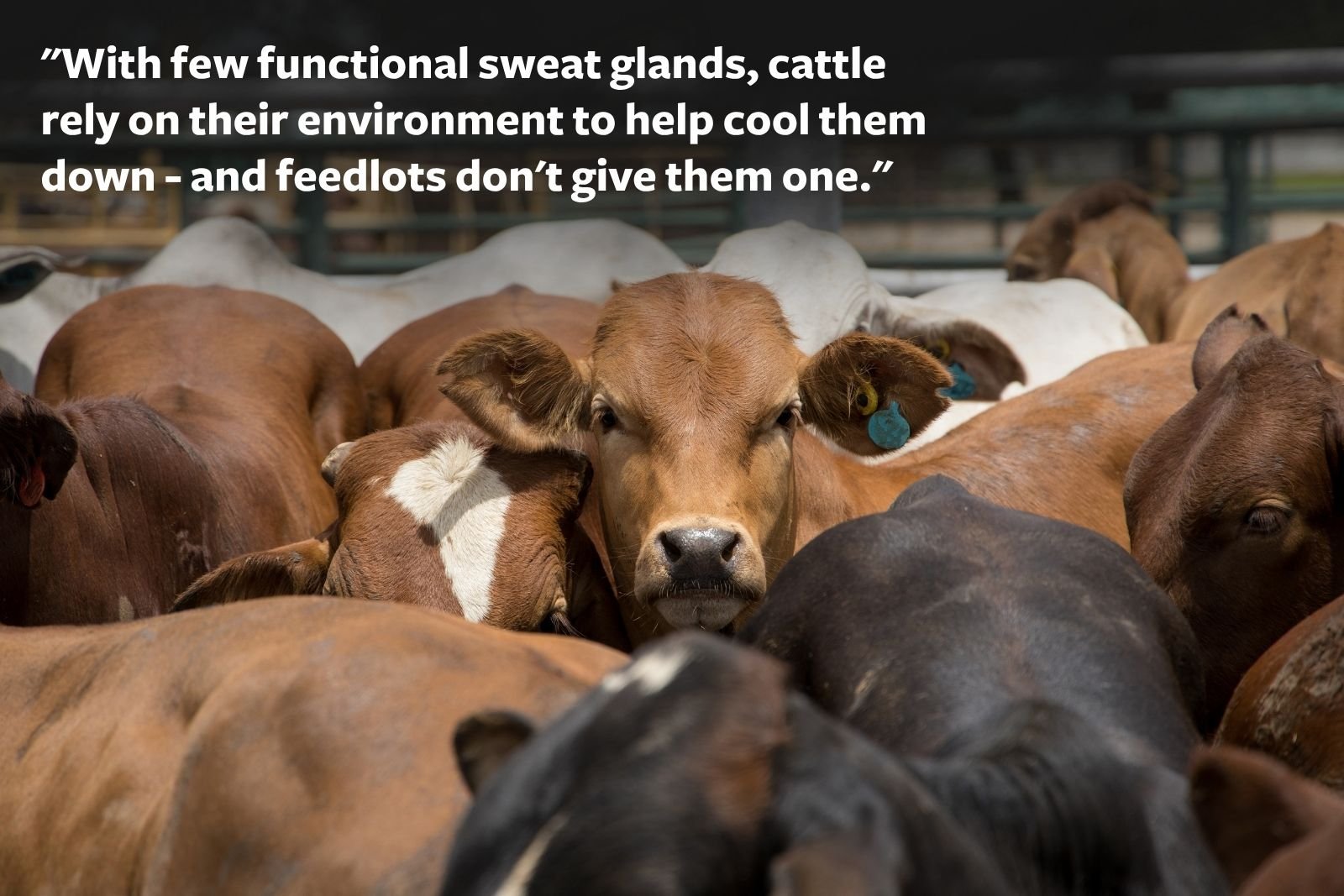
You might be wondering if farmers raising their cattle on pasture are seeing the same heat-related problems. In short, they aren’t, and here’s why. With few functional sweat glands, cattle rely on their environment to help cool them down. They’ll seek out shade, which is typically available in a pasture-based system but is often lacking in a feedlot; when it is available, it's typically inadequate.
They’ll stand rather than loafing to help with air circulation. Cattle in feedlots are often overcrowded, which limits airflow and makes it harder for them to cool off. In addition, the soil temperature in a well-vegetated pasture is much lower than bare soil, which can be hotter than the surrounding air. With lower ground temperatures and a much lower stocking rate (if you overstock a pasture, it becomes a feedlot), cattle on pasture have not only less heat radiating up from the ground but less heat radiating from their herdmates.
Cattle on pasture will choose to eat at night or first thing in the morning to avoid turning on their furnace of a digestive system. They can pick and choose when they eat rather than being fed scheduled meals.
It isn’t just the environment that affects a cow’s ability to cool herself down. In the quest for a more efficient animal, we have bred our cattle to be larger and larger. Data from Kansas State University shows that average steer weight at slaughter in July 2026 was 5% higher than just two years earlier. As you can imagine, heavy-weight cattle are at greater risk of heat stress because they have more difficulty getting rid of heat naturally. They are also more prone to heart disease, which is becoming a growing problem in the feedlot industry. There is evidence in people that heart disease reduces the ability to respond to heat, and the same is likely true for cattle. All these factors combine to make extreme weather events deadly for cattle on factory farms.
The impacts of climate change are only getting worse, and how we raise cattle is a big part of the problem since they are the largest emitters of greenhouse gases in agriculture. Evidence is growing on the ways in which human-caused climate change is impacting extreme weather events that cause so much destruction to humans, animals, and the environment. A recent report by the National Academies of Sciences found:
“Human-caused changes to the thermodynamics of the climate system have a direct and well-understood impact on extreme temperatures, extreme rainfall, and compound hot-dry events. These links are established with high confidence and are well supported by a robust combination of physical theory, observational data, and model simulations”
We need to drastically reduce the number of cattle raised in giant feedlots, both by shifting production to more sustainable pasture-based systems that reduce the negative social, animal welfare, health, and environmental impacts of feedlot livestock production and by substituting other proteins for beef.
As always, farmers and ranchers have to focus on the needs of the animals. With climate change, things that worked in the past may no longer be good enough. We can and should do better.