
Hell or High Water Farm at the Farmer’s Market
By: Samantha Gasson, Humane Farming Program Director
National farm organizations are urging the Senate Ag Committee to push their current version of the Farm Bill forward when lawmakers return in September, on the theory that a bad Farm Bill beats no Farm Bill. As a livestock and poultry farmer who sells directly to the public, I can't get behind that logic. A bad bill doesn't just fail to help; it actively guts the program that keeps my farm stand busy, and my neighbors fed.
The One Big Beautiful Bill (OBBB) already took a chainsaw to the American social safety net, including Medicaid and the Supplemental Nutrition Assistance Program (SNAP, or "food stamps" if you're old enough to remember that name), with cuts that land hardest on the people who can least absorb them, while the benefits flow upward to those who need them least. Now the long-overdue Farm Bill is caught in a fight over whether Congress should leave those cuts and cost shifts largely intact. Senate Democrats have opposed advancing a bill that fails to adequately protect SNAP and the states responsible for administering it. Because supporters would likely need 60 votes to overcome a filibuster on the Senate floor, a Farm Bill generally needs bipartisan support. This means the calls constituents make right now can actually move the needle.
Feeding the hungry is reason enough to protect SNAP, but if you are a farmer, you know that the case is bigger than that. SNAP is one of the most effective economic stimulus tools we have: USDA's Economic Research Service found that a $1 billion increase in SNAP benefits during an economic downturn generates $1.54 billion in GDP - a 1.5x multiplier - while supporting roughly 13,560 jobs nationwide, including nearly 500 in agriculture, and adding about $32 million in farm income (USDA ERS, 2019). That's not a talking point; it's USDA's own math, and it means that when you cut SNAP, you're not just cutting food assistance; you're cutting farm income and rural jobs right along with it.
Then there's what SNAP actually buys. When a recipient shops at a farmers market instead of a big-box grocery store, they're often buying produce grown closer to home, with a shorter, more traceable supply chain and less exposure to the kind of imported-produce contamination outbreaks, Cyclospora, for instance, that periodically make national headlines. They can buy meat raised without routine antibiotics and animal products raised humanely with a higher nutritional density. These foods are more readily available at farmers markets, and while typically out of reach financially, with SNAP and supplemental matching programs, low-income recipients can actually afford it. That's a public health upgrade, delivered through a program that's already on the books. Plus, SNAP dollars spent directly with local farmers allow a larger share of the purchase price to reach those producers and circulate through the regional food economy.
Redemptions at farmers markets and from direct-marketing farmers have grown substantially over the past decade as more markets got equipped to accept EBT. Even before the pandemic-era growth in food-assistance programs, farmers markets nationwide redeemed $24.4 million in SNAP benefits in 2017 - 35.2% more than in 2012, according to the Farmers Market Coalition, and that's still only a small fraction of total SNAP spending, meaning there's enormous room to grow. Our farm alone regularly turns in over $1,000 a month in SNAP tokens across the markets we sell at, and we're just one farm, at a handful of markets, in one state. Losing that income is substantial to small farms like ours.
If you walk into a farmers market with an EBT card, here is how it works. At participating North Carolina markets, a SNAP customer's first stop at the market is the Manager's Tent (every state runs it a little differently). There, they swipe their SNAP/EBT card and receive cute, market-specific wooden tokens in the amount requested, along with matching tokens, making the wooden dollars stretch further.
The swiped funds are reimbursed by the federal government, but the matching funds are a different story, as each market has to hustle for that money through grants and donations, market by market, year by year. Some states fund the match centrally, which many of us in the NC food security world are hoping our own legislature will finally do. This would allow NC market managers and market Board of Directors to focus on programming rather than securing assistance funds (having served on two area market boards, I can attest to this constant stressor).
The customer then takes these tokens and spends them at market. Vendors are trained each year, usually at our annual vendor meetings, on which foods are eligible, making sure we comply with the federal SNAP rules. Farmers then turn these tokens over to the manager who makes sure we’re reimbursed.
SNAP at the farmers market is a genuine win-win. The most vulnerable people in our community get fed, and local economies get a boost that a grocery-chain purchase never delivers in the same way. Every token spent at a farm stand is money that stays local, invested in humane, small-scale agriculture. The Farm Bill exists to support our food system. It shouldn't be used to dismantle it.
If you're a farmer selling at a market that doesn't yet accept SNAP, the Farmers Market Coalition has a step-by-step guide to get started: farmersmarketcoalition.org/education/snap. If you're an eater, ask your favorite market whether they take SNAP, and if they don't, ask them to. And whoever you are, call your senators and tell them to stand strong against a Farm Bill that guts SNAP. You can find your senator at congress.gov/members/find-your-member and reach the Capitol switchboard at (202) 224-3121.
Be part of a country that values its farmers and takes care of its most vulnerable. Right now, that starts with a phone call.
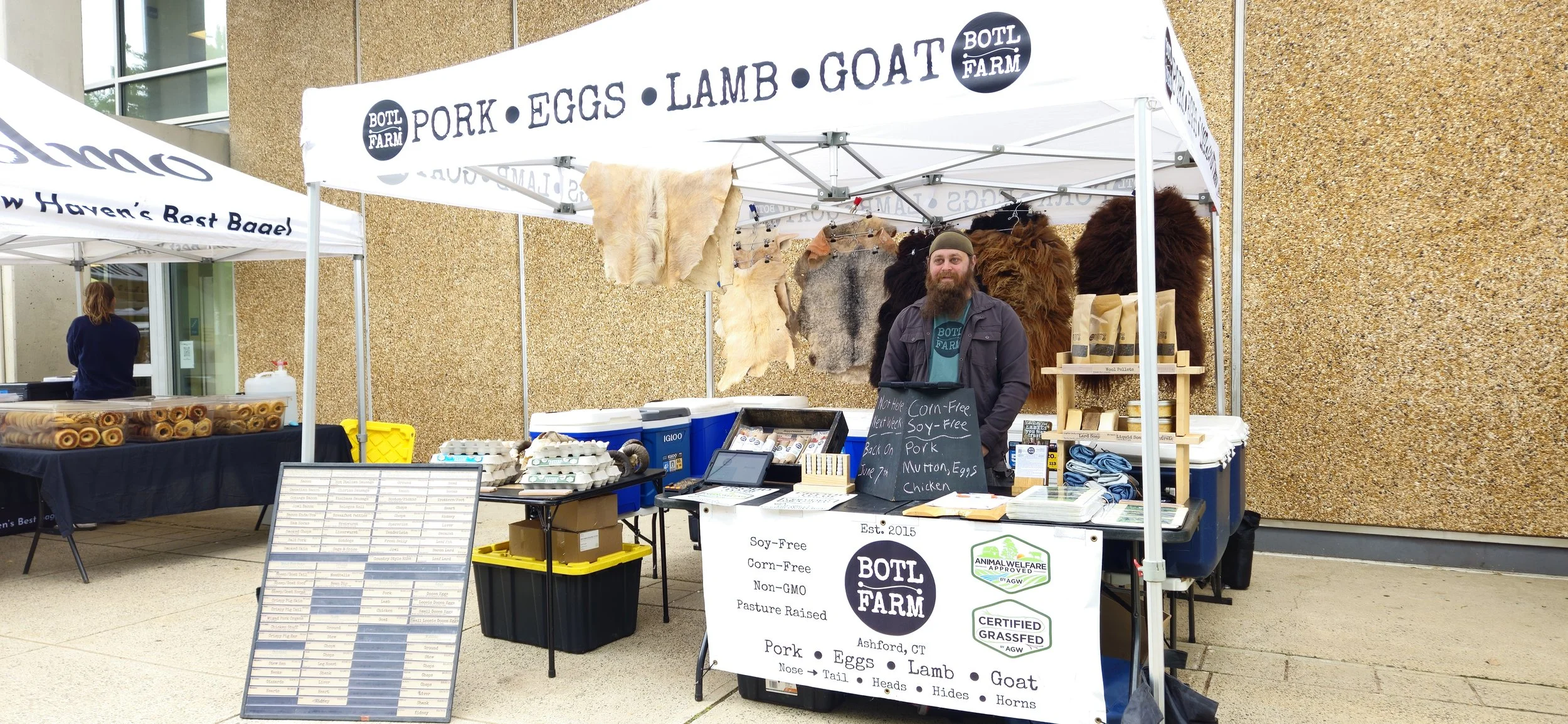
BOTL Farm at the Farmer’s Market. BOTL received a Fund-a-Farmer Grant from FACT in 2026.