From restaurant kitchens to farm fields, a FACT employee traces his journey toward understanding our food system—and the farmers working to change it.
By: Brian Wiltrout
How did things come to be this way? This is a question asked, among other mind-benders, in one of my favorite books, Ishmael, by Daniel Quinn. The book itself calls into question man’s perceived place in the world and how, as a species, we have interacted with the earth through agriculture, religion, and civilization. I’m asking it here about the American food system and recounting my interpretation. This interpretation has taken me the better part of my life so far to arrive at, with new context coming continuously.
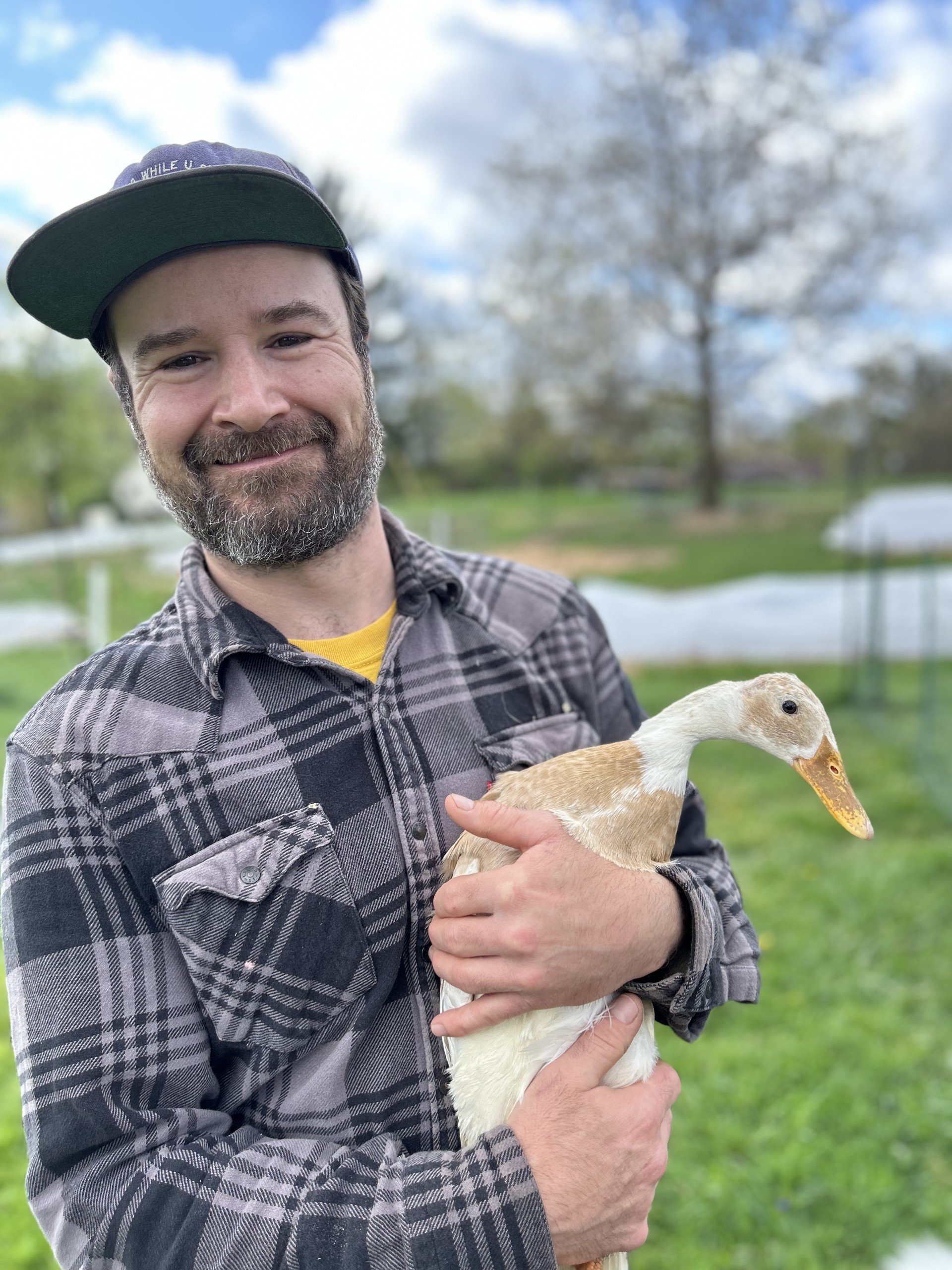
Before I ramble on any further, I should probably introduce myself. My name is Brian Wiltrout, and I am beyond excited to be the newest member of the FACT team. I started my job as a humane farming outreach associate in September, and with it, my knowledge of the food system continues to deepen.
I have always been interested in where food comes from. As a kid, this seemed like a pretty simple concept. You go to the grocery store to get food. This was my experience. My mom would put me in the “child seat” that used to be in the front of shopping carts, facing her, with my little legs dangling as she weaved through the aisles of Giant Eagle.
I was raised in the suburbs of Pittsburgh, PA, by loving and caring parents, in a stable household of five. In the tradition of 1990s American suburban life, this stability was aided, in part, by relatively new household conveniences, particularly in how we purchased and consumed food. I later came to learn that this cultivated convenience, present in many aspects of suburban life at the time, was happening in tandem with the industrialization of our agricultural system.
It wasn’t until I was a good bit older that I came to realize that a lot of that food came from factories. Even the vegetables came from places that looked nothing like the farms I saw when I drove around Pennsylvania farm country with my Dad. I often wondered, where are the vegetables? Why so much corn? I see a few cows, but where are the pigs and chickens? Where does all this hay go?
As I got older and took jobs in food service, this curiosity about food turned into a full-on investigation into how food systems work. At first, I worked in concession stands, fast food, and bar/grill type restaurants. The food served in these places looked much like grocery store products, packaged in larger quantities and arriving on large refrigerator/freezer trucks.
As I took jobs in better restaurants, I noticed differences. Produce came in pickup trucks and small box trucks, and the person handing it off wasn't a delivery driver, but a farmer, sometimes still dirty and stinky from the field. The chickens would come from a guy named Pete, who lugged in big white coolers full of whole birds packed in simple plastic bags. Pete was as friendly as a person could be and always had a minute to talk about his chickens. He also always looked tired. I came to realize Pete was one of the few folks around doing things this way, at the time. All of this food was clearly higher quality. It tasted better, looked better, and felt healthy.
The investigation turned to passion. I only wanted to work in places like this. As I progressed in my career, I got to know many local farmers and their stories. We would buy lamb from John, still delivering his meat in his pickup truck. He told me stories about starting his farm and business before there were even nice restaurants in the area, and about starting a mail-order service to supply fine-dining restaurants in New York. He made a name for himself and built a decent business, but he still delivered his lamb right to the back door and stopped to talk about it.
Pittsburgh’s dining culture had progressed by this time, and there were many restaurants opening, with a lot of them wanting to source from local farmers. My chef career also progressed to ordering the food, and eventually to butchery and charcuterie. Jeremy would bring us whole pigs and take the time to talk about how difficult it is to manage expectations, commitments, and numbers, with living animals.
During this time, I was able to piece together other parts of the food system, at least locally. I learned how thin the margins were for farmers, and that they often served as their own sales department and delivery service. I learned how few local supply chains there were, and how it would never make financial sense as a small producer to sell into the larger ones.
In spite of all of this, or maybe because of it, I decided I also needed to be a farmer. I left the kitchen and became one of the stinky people bringing produce, or pork or lambs to the back door of the restaurant. I also met many more farmers, and heard many more stories. Stories about Pennsylvania’s struggling dairy farmers. I connected this to my childhood memories of farms and realized that making hay for dairy cattle, along with corn and soybean subsidies, were the only things keeping many farms in my area going at that time. I learned that corporate consolidation of farms and distribution channels, coupled with legislation that supported this shift, made it increasingly difficult for local producers to compete.
All of this created a disconnect about how we keep our families healthy. A large portion of the American public was slowly tricked into thinking that the production of food is cheap, fast, and healthy (good). Any farmer would tell you that you can’t have all three. All the while, consolidation deepened, and quality kept dropping.
It feels now like another shift is happening. The quality of food produced through the industrial system has become so dismal, and its negative health effects so obvious, that calls for transparency in our food system have become mainstream.
Above all else, I learned that farmers, and people called to farm, are innovative, resilient, and adaptive. When COVID shut down restaurants and disrupted local and national supply chains, farmers stepped up, filled the gaps, built new supply chains, and supported their local communities. This did not go unnoticed, and the question of how did things come to be this way? began echoing more loudly from the chambers of Congress to the grocery aisles. And who better to answer that behemoth of a question than your local farmer, who shows up, again and again, at restaurant back doors with gritty fingernails, asking to be let into a food system that keeps trying to shut them out.