By: Samantha Gasson, Humane Farming Program Director and Farm Owner of Bull City Farm
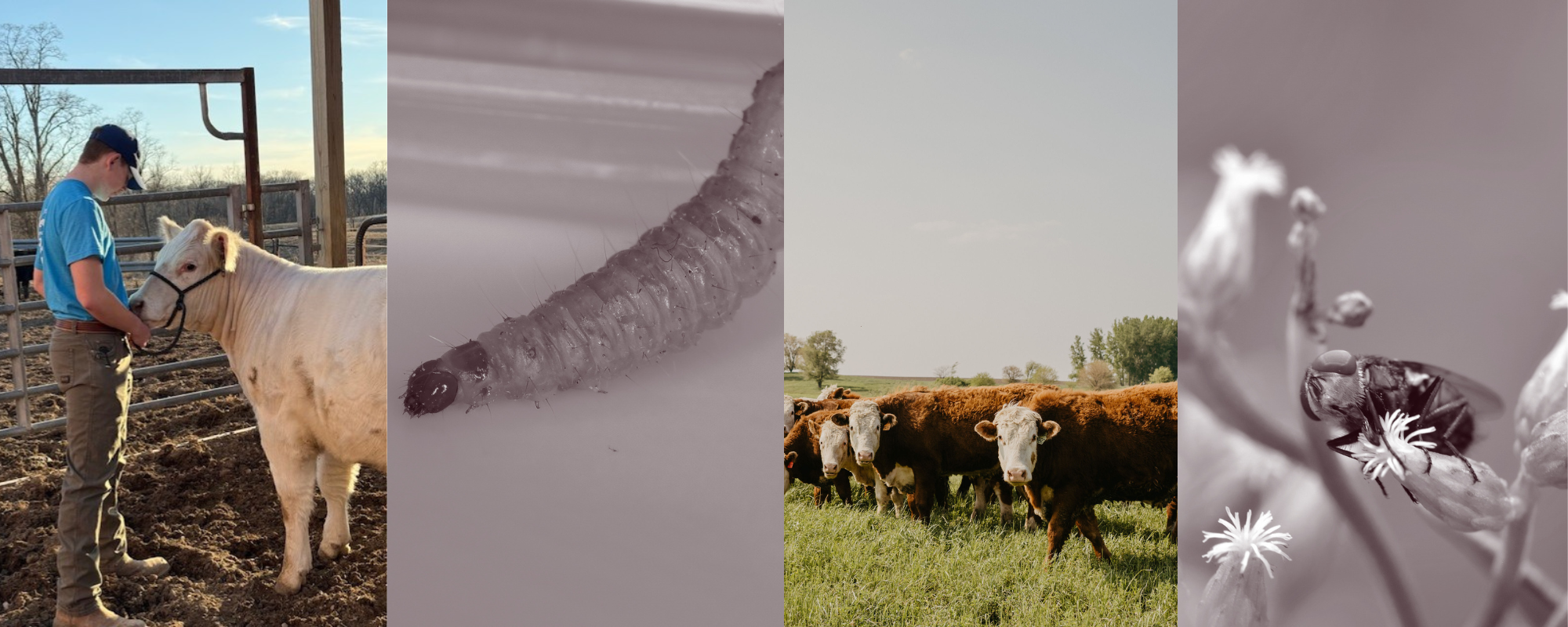
If the North Carolina drought wasn't enough to keep me up at night, the world gave us a resurgence of the Screwworm fly. This flesh-eating nightmare is a type of blow fly, with many native species in the US. Unlike its carrion and necrotic flesh-eating cousin, this minute menace prefers something fresher, as in very fresh, preferably with a blood supply.
Time for a short biology lesson. Up until the 1950’s, this colorful fella wreaked havoc on the beef industry. Like many of us, they love beef, especially the wet and warm umbilical cords of newborn calves. They’re not too picky, though, and will lay eggs around any wound no matter the size, and, if they can’t find a wound, they’ll lay eggs in the soft squishy bits like the nose, inside the ears or on the genitals.
The female screwworm lays hundreds of eggs, which can hatch in as few as twelve hours, then she adds a few pheromones into the mix, leaving behind the screwworm’s version of a huge neon "eat here" sign. Once hatched, the larvae start munching away for the next 5-7 days. On day eight, all nice and full, they drop off their host, burrow into the soil,, and pupate for around a week if the soil temperature is warm, but up to 57 days if it's cool. They're like most true southerners and prefer an ambient temperature in the mid-80s.
Their nasty habit of eating warm-blooded animals alive has understandably given them a bad rap,, which is why, in the 1950's, a huge North American effort to eliminate the screwworm by releasing irradiated (yep, screwworms rich in radiation) sterile screwworms was launched. This was hugely successful because the female's habit of mating only once in her lifetime. By 1959, the screwworm was eliminated from North and South Carolina, and by 2001, Panama said bye-bye to the carnivorous menace.
Now, you might be wondering how, after decades, we are seeing a resurgence of the screwworm in North America. Well, as is often the case, it is due to many factors. Since the eradication of the screwworm from North America, Panama has been the gatekeeper with the last remaining producer of sterilized screwworms. They transport their product to dispersal facilities in Central America and Mexico, where the flies are dyed and released into the wild. They’re dyed, which I think is so clever, so that when trapped, inspectors know where the sterile heroes came from.
Unfortunately, in 2022, the Panama facility had multiple bad batches of flies that, unbeknownst to them, weren't as vigorous, leading to fewer sterile matings with wild females. Added to this unfortunate event is the DOGE cuts to USAID (U.S. Agency for International Development), a program that, among other things, monitors the New World screwworm migration, which in 2024 was well into Mexico. Add in a temporary suspension of cattle importation from Mexico to reduce beef prices for the consumer (even though the government was strongly advised not to do so because of the prevalence of screwworms in Mexico), and the perfect storm happened, allowing for the reintroduction of the screwworm into the US.
What does this mean for the US as a whole? Probably higher beef prices in the short term until more facilities can come online to produce the 5 million sterile flies a week it took to eradicate the flesh-eating flies in the 1960's. This probably won't be until around 2028, according to the NCDA.
Luckily, when detected early, a screwworm infestation of an individual animal can be treated. Humans aren’t as susceptible due to our habit of going to the doctor when we see maggots in a wound. Poultry is also less affected, probably because they are fastidious about preening.
If you're a bit of a geek, like me, and would like to keep up with the spread of the screwworm live, you can on the APHIS website (you can track bird flu here as well). https://www.aphis.usda.gov/animals/animal-health/livestock-and-poultry-disease/current-status/us-confirmed-cases-new-world